

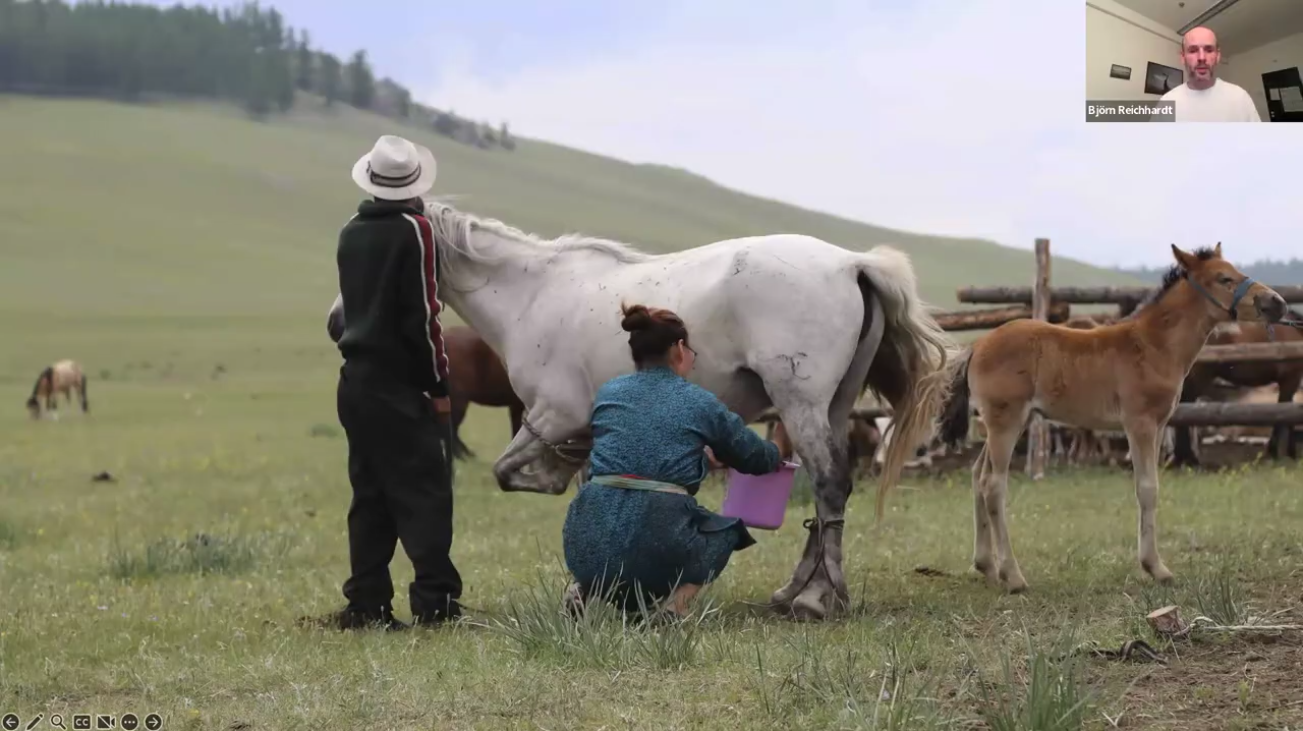
On November 19th, the IAUNRC welcomed Dr. Björn Reichhardt to deliver a talk that concluded the fall semester’s installments of the “Security across Central Eurasia” series. Dr. Reichhardt, a Central Asian Seminar Postdoctoral Research Associate at the Institute for Asian and African Studies at Humboldt-Universität zu Berlin, presented his findings on the importance of dairy fermentation as practiced by pastoral herder women and its role in perpetuating knowledge and bio-social growth for Mongolian communities.
Dr. Reichhardt began his talk by defining food security as “the conditions necessary to ensure people can secure a sufficient and healthy diet.” The concept of food security addressed hunger-starved populations in different areas of the Eurasian landmass, and the definition that Reichhardt uses focuses on four main characteristics: availability, access, stability, and utilization. Due to ecological crises, climate events, the COVID-19 pandemic, and the Russian invasion of Ukraine in 2022, the already strained linkage between food systems and ecological systems weakened further. According to research on food access and availability in Mongolia, one of the biggest challenges, as Dr. Reichhardt explains, is increasing both the scale and longevity of domestic food production and supporting local food producers. This challenge, as he described, represents a tangible detriment to sovereignty due to increased reliance on imports.
In post-socialist Mongolia, economic stratification and wealth disparity worsened, and the term “market economy” came to be associated with constant fears of discontinuity and instability. Mongolian political regime changes affected processes of hygiene and standardization, which in turn impacted dairy cultures, or the “biological and cultural relationships between humans, livestock, milk, and microbes.” Mongolian dairy cultures, as Dr. Reichhardt explains, affect every level of stability for communities, starting from the microbial level as a reflection of dairy production techniques. A paradoxical element of researching Mongolian milk production, however, deals with the fact that, despite the high percentage of lactose intolerance among the modern Mongolian population (approximately 90%), Mongolians have historically produced and actively consumed milk products as a staple of daily life. Additionally, milk is a highly symbolic foodstuff, evoking sentiments of purity, pastoral heritage, and maternalistic community values. The history of milk and dairying is complicated, however, due to the lack of archaeological sources and accounts that trace the spread of techniques between different Mongolian territories.
Based on multi-sensory ethnographic fieldwork interacting and learning from Mongolian herders, Dr. Reichhardt then elaborates traditional forms of dairying knowledge production, such as insistence on organic dairying equipment like wooden milking buckets that retain a rich flavor and lack synthetic elements or chemicals. Lactic ferments, or starter cultures for dairy production, carry an immense cultural heritage because they are meticulously curated and utilized as teaching points for knowledge production in communities. Each batch of products begins from the same cultures, as Dr. Reichhardt explains, and these starter cultures feed households, generate bio-social and economic growth, and carry knowledge into new generations day-by-day. Neighbors and communities often share starter cultures, which speaks to grassroots visions of sustainability. Dr. Reichhardt’s talk imbued the audience with the central idea that milk acts as a focal point for a maintenance-based relationship between humans, livestock, and microbes. Care and preservation of community-focused knowledge production is an invaluable aspect of increasing sustainability and combatting privatized dairy production networks that contribute to diseases and ecological decline.
The IAUNRC thanks Dr. Reichhardt for his informative and fascinating lecture and looks forward to future opportunities in collaboration as well as the continuation of the Security series.